Showing posts with label candomble. Show all posts

Monday, May 18, 2015

The ABCs of Spells... Spelling

Thank God for the internet, the wonderful world wide web.  You can google just about anything.  Google however is Artificial intelligence, an algorithm, you can only get out what was put in.   

Many search for spells on the net.  People seek spells for love, work, money, etc.  Yet, you know when you cast your net you can draw up things that want, and others that you do not.  The beauty that we have is natural intelligence.  As beings we have the power to create.

Yes, others can effectively petition on your behalf.  However,  No one can speak to your situation, greater, than you. You are going through your own experience. If it is your desire to become a mambo, hougan, shaman, etc, this is an indispensable skill.

The truth is a lot of people do not know how to spell. Being able to spell is the ability sum up how you feel. (A spell enhances your confidence that will get you a job, an interview, your money back, your to get your personality across.  Your words is your sword, and your vocabulary is vehicle that drive them into existence.

A spell consists of words to command a certain outcome.  Yes, spelling that which we learned in elementary school is important. Words have power! Re- read the sentence...

While in school, I have heard some say I do not see why this is important I am not going to use this in "real" life!?! Spelling seems crazy, illogical, and 'weird', right? But there are patterns, rules & reasons why some words are spelled the way they are - honestly!

One of the main complaints I here that I do not have...
Statistics state that:
2/3 of American students who aren't proficient readers by the grade will end up in jail or on welfare.
61% of low income families don't have books at home... 
1 in 4 American children never learn how to read. 


Interesting numbers, when education in America is, free. It's never too late to improve your spelling, thus your spells. Do something now to improve your spelling. It is useful for your personal altar work, addressing the lwa, and magic. 

Learning all about why we spell the way we do.  Notice spelling patterns, and using spelling strategies will improve your spells--- spelling, writing and confidence.


Monday, January 2, 2012

The Fall of the Kings, The story of the Three Wiseman/ or Kings?

Fet Les Rois or Kings Day is celebrated January 6th in Haiti. January 6 - Les Rois (the kings) Also called Kings Day.  Simbi Dlo, Simbi Andezo and Simbi Anpaka are celebrated on this date in  Northern Haiti

There are several stories that are interrprated from this biblical story.   These three "Kings" followed a star that lead them to the birth place of the Jesus the Christ of Bethlem. 

They are regular figures in traditional accounts of the nativity celebrations of Christmas and are an important part of the Christian tradition.

All stories of the bible are embedded if not founded upon symbology.

In Haitian Vodou, Simbi (also Sim'bi) is a large and diverse family of serpent Loa (Vodoun spirit) from the West Central Africa / Kongo region. Some prominent Simbi Loa include Simbi Dlo (also Simbi d'l'eau - Simbi of the Water), Simbi Makaya, Simbi Andezo (Simbi of Two Waters), and Gran Simba. Traditionally in their Kongo context they are all associated with water, but in the Haitian Vodoun context they have wide ranging associations. For example Simbi Makaya is a great sorcerer, and served in particular in the Sanpwel secret societies. Simbi Anpaka is a Loa of plants, leaves, and poisons.

Simon the Sorcerer or Simon the Magician, in Latin Simon Magus, (Greek Σίμων ὁ μάγος) was a Samaritan magus or religious figure and a convert to Christianity, baptised by Philip the Evangelist, whose later confrontation with Peter is recorded in Acts 8:9-24. The sin of simony, or paying for position and influence in the church, is named for Simon. The Apostolic Constitutions also accuses him of lawlessness.[1]

In apocryphal works including the Acts of Peter, Pseudo-Clementines, and the Epistle of the Apostles, Simon also appears as a formidable sorcerer with the ability to levitate and fly at will.

It is ironic that Simon and Peter are synonmous and that Jesus declared that Peter was the "Rock" that the Church was to be built upon and as a result he was issued the "Keys" and is claimed to be the 1st bishop of the church?


Take a good look at this picture does anything stand out?
The Magi  also referred to as the (Three) Wise Men, (Three) Kings, or Kings from the East, were a group of distinguished
  •  foreigners
  •  who followed a star
  •  that lead to the visit
Jesus after his birth, bearing gifts of gold, frankincense and myrrh.
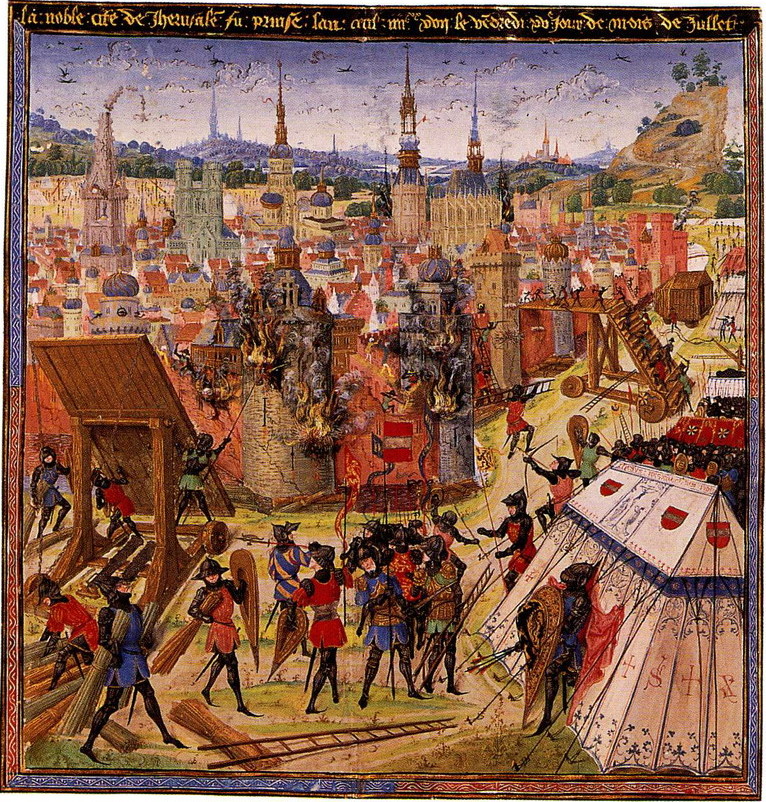
File:1099jerusalem.jpg
Medieval illustration of capture of Jerusalem during the First Crusade, 1099

Bethlehem lit "House of Flesh";, lit "House of Bread;" located in the central West Bank and approximately 8 kilometers south of Jerusalem,

The city was sacked by the Samaritans in 529 AD but rebuilt by the Byzantine emperor Justinian I. Bethlehem was conquered by the Arab Caliphate of 'Umar ibn al-Khattāb in 637, who guaranteed safety for the city's religious shrines. In 1099, Crusaders captured and fortified Bethlehem and replaced its Greek Orthodox clergy with a Latin one. The Latin clergy were expelled after the city was captured by Saladin, the sultan of Egypt and Syria.

Jerusalem is a holy city to the three major Abrahamic religionsJudaism, Christianity and Islam. In Judaism, Jerusalem has been the holiest city since, according to the Biblical Old Testament, King David of Israel first established it as the capital of the united Kingdom of Israel in c. 1000 BCE, and his son Solomon commissioned the building of the First Temple in the city.

 Their identification as kings in later Christian writings is probably linked to Psalms 72:11, “May all kings fall down before him”.[4]

The New Revised Standard Version of Matthew 2:112 describes the visit of the Magi:
The Magi are popularly referred to as wise men and kings. The word magi is the plural of Latin magus, borrowed from Greek μάγος magos,[5] as used in the original Greek text of the Gospel of Matthew. Greek magos itself is derived from Old Persian maguŝ from the Avestan magâunô, i.e. the religious caste into which Zoroaster was born, (see Yasna 33.7: "ýâ sruyê parê magâunô " = " so I can be heard beyond Magi "). The term refers to the priestly caste of Zoroastrianism.[6] As part of their religion, these priests paid particular attention to the stars, and gained an international reputation for astrology, which was at that time highly regarded as a science. Their religious practices and use of astrology caused derivatives of the term Magi to be applied to the occult in general and led to the English term magic. Translated in the King James Version as wise men, the same translation is applied to the wise men led by Daniel of earlier Hebrew Scriptures (Daniel 2:48). The same word is given as sorcerer and sorcery when describing "Elymas the sorcerer" in Acts 13:6–11, and Simon Magus, considered a heretic by the early Church, in Acts 8:9–13. However, there are some[who?] who argue that the magi might have been astronomers, and not astrologers.

Traditions identify a variety of different names for the Magi.

In the Western Christian church they have been commonly known as:

These names apparently derive from a Greek manuscript probably composed in Alexandria around 500 A.D., and which has been translated into Latin with the title Excerpta Latina Barbari.[7] Another Greek document from the 8th century, of presumed Irish origin and translated into Latin with the title Collectanea et Flores, continues the tradition of three kings and their names and gives additional details.[8][9]

 Origin and journey

James Tissot - The Magi Journeying (Les rois mages en voyage) - Brooklyn Museum
The phrase from the east, more literally from the rising [of the sun], is the only information Matthew provides about the region from which they came. According to the Gospel of Matthew, the Magi found Jesus by 'following' a star,[15] which thus traditionally became known as the Star of Bethlehem. Various theories have been presented as to what this phenomenon refers to, since stars do not visibly move and therefore cannot be followed. Some believe that they followed a planet, which without a telescope could be mistaken as a star, as it slowly moved across the sky.

On finding him, they gave him three symbolic gifts: gold, frankincense and myrrh. Warned in a dream that Judean king Herod intended to kill the child, they decided to return home by a different route. This prompted Herod to resort to killing all the young children in Bethlehem, an act called the Massacre of the Innocents, in an attempt to eliminate a rival heir to his throne. Jesus and his family had, however, escaped to Egypt beforehand. After these events they passed into obscurity.[16] The story of the nativity in Matthew glorifies Jesus, likens him to Moses, and shows his life as fulfilling prophecy.[17]

The Code noir (French pronunciation: [kɔd nwaʁ], Black Code) was a decree originally passed by France's King Louis XIV in 1685. The Code Noir defined the conditions of slavery in the French colonial empire, restricted the activities of free Negroes, forbade the exercise of any religion other than Roman Catholicism (it included a provision that all slaves must be baptized and instructed in the Roman Catholic religion), and ordered all Jews out of France's colonies. The Code Noir also gave plantation owners extreme disciplinary power over their slaves, including legitimizing corporal punishment as a method of maintaining control


The "Bulla" (Seal)
The most distinctive characteristic of a bull was its metal seal, which was usually made of lead, but on very solemn occasions was made of gold (as Byzantine imperial deeds often were). The "bulla" depicted the founders of the Church of Rome, the apostles Peter and Paul, identified by the letters Sanctus PAulus and Sanctus PEtrus. The name of the issuing pope was usually on the reverse side. The seal was then attached to the document either by cords of hemp (in the case of executory letters or letters of justice) or by red and yellow silk (in the case of letters of grace), which was looped through slits in the vellum of the document. Bulla is the name of this seal, which to ancient observers looked like a bubble floating on water: Latin bullire, "to boil."

Louisiana's Code Noir (1724)

Primary Documents:
To regulate relations between slaves and colonists, the Louisiana Code noir, or slave code, based largely on that compiled in 1685 for the French Caribbean colonies, was introduced in 1724 and remained in force until the United States took possession of Louisiana in 1803. The Code’s 54 articles regulated the status of slaves and free blacks, as well as relations between masters and slaves.

Thursday, December 8, 2011

What's the Coverup? The Misconception continues!!!

Matka Boża Niepokalana
Advent (from the Latin word adventus meaning "coming") is a season observed in many Western Christian churches, a time of expectant waiting and preparation for the celebration of the Nativity of Jesus at Christmas. It Advent starts on the fourth Sunday before December 25, the Sunday from November 27 to December 3 inclusive.

For Christians, the season of Advent serves as a reminder both of the original waiting that was done by the Hebrews for the birth of their Messiah as well as the waiting of Christians for Christ's return.

http://en.wikipedia.org/wiki/Advent

The winter solstice occurs exactly when the axial tilt of a planet's polar hemisphere is farthest away from the star that it orbits. The seasonal significance of the winter solstice is in the reversal of the gradual lengthening of nights and shortening of days. Depending on the shift of the calendar, the winter solstice usually occurs on December 21 or 22 each year in the Northern Hemisphere, and June 20 or 21 in the Southern Hemisphere.[3]
Worldwide, interpretation of the event has varied from culture to culture, but most cultures have held a recognition of rebirth, involving holidays, festivals, gatherings, rituals or other celebrations around that time.[4]

http://en.wikipedia.org/wiki/Winter_Solistice


Horus is one of the oldest and most significant deities in the Ancient Egyptian religion. These various forms may possibly be different perceptions of the same multi-layered deity in which certain attributes or syncretic relationships are emphasized, not necessarily in opposition but complementary to one another, consistent with how the Ancient Egyptians viewed the multiple facets of reality.[2]
The earliest recorded form is Horus the Falcon who was the patron deity of Nekhen in Upper Egypt and who is the first known national god, specifically related to the king who in time came to be regarded as a manifestation of Horus in life and Osiris in death.[1] The most commonly encountered family relationship describes Horus as the son of Isis and Osiris but in another tradition Hathor is regarded as his mother and sometimes as his wife.[1]  http://en.wikipedia.org/wiki/Horus


Horus was often the ancient Egyptians' national patron god. He was usually depicted as a falcon-headed man wearing the pschent, or a red and white crown, as a symbol of kingship over the entire kingdom of Egypt.
God of the king, the sky and vengeance
Major cult centerNekhen, Behdet Edfu
SymbolThe wedjat eye
ParentsOsiris and Isis in some myths, and Nut and Geb in others.
SiblingsAnubis (in some accounts) or Osiris, Isis, and Nephthys
ConsortHathor (in one version)


In Haitian Vodou, Papa Legba is the intermediary between the loa and humanity. He stands at a spiritual crossroads and gives (or denies) permission to speak with the spirits of Guinee, and is believed to speak all human languages. He is always the first and last spirit invoked in any ceremony, because his permission is needed for any communication between mortals and the loa - he opens and closes the doorway[1]. In Haiti, he is the great elocution, the voice of God, as it were. Legba facilitates communication, speech and understanding.

He usually appears as an old man on a crutch or with a cane, wearing a broad brimmed straw hat and smoking a pipe, or sprinkling water. The dog is sacred of him. Because of his position as 'gate-keeper' between the worlds of the living and the mysteries he is often identified with Saint Peter who holds a comparable position in Catholic tradition. He is also depicted in Haiti as St. Lazarus,[2] and St. Anthony. [3]
In Benin and Nigeria, Legba is viewed as young and virile, is often horned and phallic, and his shrine is usually located at the gate of the village in the countryside.


Detail from Albrecht Dürer
Simon Peter is venerated in multiple churches and is regarded as the first Pope by the Roman Catholic Church.

According to New Testament accounts, he was one of Twelve Apostles, chosen by Jesus from his first disciples. He was a fisherman assigned a leadership role by Jesus and was with Jesus during events witnessed by only a few Apostles, such as the Transfiguration.[6]


Capricorn' () is the tenth astrological sign in the Zodiac, originating from the constellation of Capricornus. In astrology, Capricorn is considered an introvert sign,[1] an earth sign, and one of the four cardinal signs. Capricorn is ruled by the planet Saturn. Individuals born when the Sun was in this sign are considered Capricorn individuals. Under the tropical zodiac, the Sun enters Capricorn by definition at the moment of winter solstice, or roughly at December 22, and leaves it around January 20.

Capricorn is sometimes depicted as a sea-goat, and sometimes as a terrestrial goat. The reasons for this are unknown, but the image of a sea-goat goes back at least to Babylonian times. Furthermore, the Sumerian god Enki's symbols included a goat and a fish, which later combined into a single beast, the goat Capricorn, recognized as the Zodiacal constellation Capricornus.

 The Parable of the rich man and Lazarus (also called the Dives and Lazarus or Lazarus and Dives) is a well known parable of Jesus which appears in one of the Four Gospels of the New Testament.
According to Gospel of Luke (Luke 16:19–31), the parable tells of the relationship, in life and in death

Many allusions to Lazarus (particularly those involving the idea of resurrection from the dead) should be understood as referring to the Lazarus described in John


Anthony of Padua or Anthony of Lisbon, O.F.M., (born Fernando Martins de Bulhões; 15 August 1195 – 13 June 1231)[1] was a Portuguese Catholic priest and friar of the Franciscan Order.

After his ordination to the priesthood, Fernando was named guestmaster and placed in charge of hospitality for the abbey. It was in this capacity, in 1219, that he came into contact with five Franciscan friars who were on their way to Morocco to preach the Gospel to the Muslims there. Fernando was strongly attracted to the simple, evangelical lifestyle of the friars, whose order had been founded only eleven years prior. In February of the following year, news arrived that the five Franciscans had been martyred in Morocco, the first to be killed in their new order.

St. Anthony, is the Patron Saint of Lost items,  things that make you go HUMmmm???