Showing posts with label santeria. Show all posts

Monday, December 19, 2011

St. Nicholas, the Father or Overseer of Vodou?


Image of St.Nicholas
sorry I'm unable to rotate this pic on this blog


Perhaps this will serve as better imaginery!-)


Historically, we were told that Christopher Columbus landed on Mount Saint Nicholas in Haiti. Just as the Pilgrimages landed on Plymouth Rock in America.  Malcom X said it beautifully Plymouth Rock landed on us.   It is known that things fell apart once the infmaous Christoher Columbus landed anywhere.   Although, he did not discover anything, anyone, or anywhere for that matter.  His contribution, however, was the Colonization of the islands.  So, just who is St. Nicholas and what does he represent.   I have seen this particular image on my mother's altar for quite sometime, but there was always a question mark as to who or what he represented in Haitian Vodou.  Culturally, some people do not understand why things are done it is just accepted as the norm.   Finally, I have put the pieces together.  

Check out this piece written in wikipedia about St. Nicholas, and Sinterklaas

Although he is usually referred to as Sinterklaas, he is also known as De Goedheiligman (The Good Holy Man), Sint Nicolaas] or simply as De Sint.  He is celebrated annually on Saint Nicholas' eve (5 December) or on the morning of 6 December in Belgium and Northern France. Originally, the feast celebrates the name day of Saint Nicholas — patron saint of children, sailors, and the city of Amsterdam, among others. Sint Nicholas being a bishop and this geographical spread make clear that the feast in this form has a Roman-Catholic background.

Sinterklaas carries a staff and has mischievous helpers with black faces!?!


Middle Ages
Originally, the Sinterklaas feast celebrates the name day, 6 December, of the Saint Nicholas (280–342), patron saint of children. Saint Nicholas was a Greek bishop of Myra in present-day Turkey. In 1087, his relics were furtively translated to Bari, in southeastern Italy; for this reason, he is also known as Nikolaos of Bari. Bari later formed part of the Spanish Kingdom of Naples, because it was previously conquered in 1442 by Alfonso V of Aragon. The city thus became part of the Kingdom of Aragon and later to Spain, until the eighteenth century. Due to the fact that the remains of St. Nicholas were in Bari (then a Spanish city), is this tradition that St. Nicholas comes from Spain. His helper is black because at the time Spain was part of the Moor empire. St. Nicholas is well known in Spain as the patron of sailors. That's why St. Nicholas comes to the Netherlands in a steamboat. St. Nicholas fame spread throughout Europe. The Western Catholic Church made his name day a Church holiday. In the north of France, he became the patron saint of school children, then mostly in church schools. The folk feast arose during the Middle Ages. In early traditions, students elected one of them as "bishop" on St. Nicholas Day, who would rule until December 28 (Innocents Day). They sometimes acted out events from the bishop's life. As the festival moved to city streets, it became more lively.[2]
Sinterklaas is assisted by many mischievous helpers with black faces and colourful Moorish dresses. These helpers are called 'Zwarte Pieten' (Black Petes). During the Middle-ages Zwarte Piet was a name for evil. Although the character of Black Pete later came to acquire racial connotations, his origins were in the evil figure. Good and bad play an important role in the feast: good is rewarded, bad and evil is punished. Hence the duplication of the one Saint in a saint and a (frolicking) devil.

The feast was both an occasion to help the poor, by putting money in their shoes (which evolved into putting presents in children's shoes) and a wild feast, similar to Carnival, that often led to costumes, a "topsy-turvy" overturning of daily roles, and mass public drunkenness.

[edit] 16th and 17th Century

After the rebellion of the 17 Dutch provinces against the Spanish Empire, Calvinist regents and ministers prohibited celebration of the Saint. The Republic of the United Provinces became an officially Protestant country following the Reformation, and its governments abolished public celebrations. The South, however, remained Catholic. People there and students in Amsterdam, also Catholic, protested. The governments were forced to allow celebration within the family.

19th Century

 Perhaps building on the fact that Sint Nicholas historically is the patron saint of the sailors (many churches dedicated to him have been built near harbors), Schenkman could have been inspired by the Spanish customs and ideas about the saint when he portrayed him arriving via the water in his book. Schenkman introduced the song Zie ginds komt de stoomboot ("Look over yonder, the steamboat is arriving"), which is still popular in the nation.
In Schenkman's version, the medieval figures of the mock devil, which later changed to Oriental or Moorish helpers, was portrayed for the first time as black African and called Zwarte Piet (Black Peter).[2] He is a negro boy who accompanies Sinterklaas and helps him on his rounds (possibly derived from the Dutch colonial experience, or the Moorish occupation of Spain, the main Catholic nation.) Traditionally Sinterklaas only had one helper, whose name varied wildly. "Piet(er)" the name in use now can be traced back to a book from 1891.

According to the more modern Saint Nicholas legend, a Zwarte Piet is a servant who accompanies Saint Nicholas on his holiday travels. In some versions, Saint Nicholas is said to have liberated a young slave named Peter, who decided to serve Nicholas. Zwarte Piet is today commonly depicted as a black person in the colorful pantaloons, feathered cap and ruffles of a Renaissance European page, a tradition that started based on a single illustration in a book published in 1850.
File:Sintenpiet.jpg
Until the second half of the 20th century, Saint Nicholas' helper was not too bright, in line with the old colonial traditions. Once immigration started from the former colonised countries Zwarte Piet became a much more respected assistant of Saint Nicholas, who is often a bit inattentive, but playfull.[8]
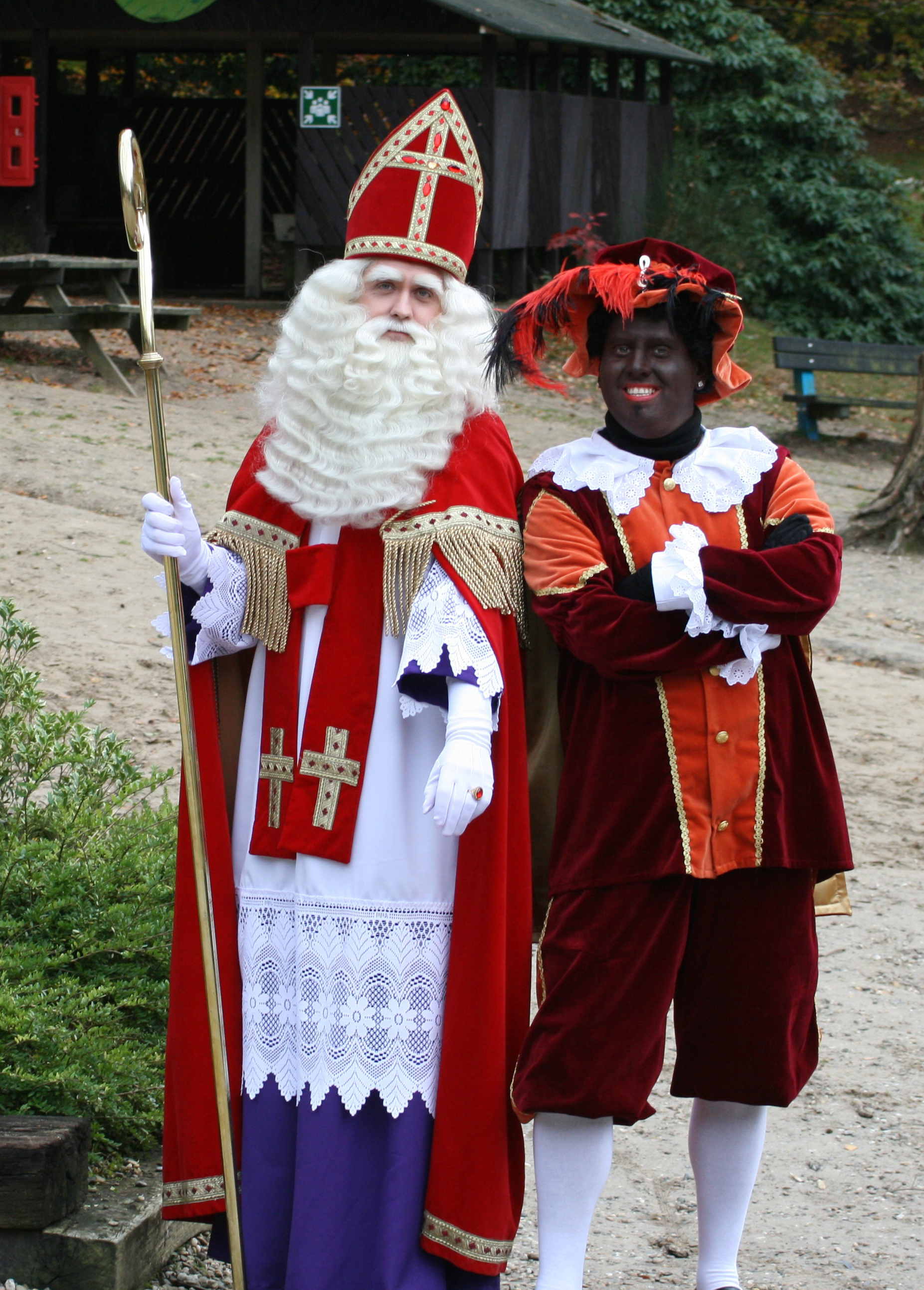
According to the more modern Saint Nicholas legend, a Zwarte Piet is a servant who accompanies Saint Nicholas on his holiday travels. In some versions, Saint Nicholas is said to have liberated a young slave named Peter, who decided to serve Nicholas. Zwarte Piet is today commonly depicted as a black person in the colorful pantaloons, feathered cap and ruffles of a Renaissance European page, a tradition that started based on a single illustration in a book published in 1850.
Zwarte Pieten are often portrayed as mischievous but rarely mean-spirited characters. The character is believed to have been derived from pagan traditions of evil spirits. Also told for decades is a story that the Zwarte Pieten are black because of chimney soot and/or in mockery of the darker Spanish occupiers of the Low Countries in centuries past.

During recent years the role of Zwarte Pieten has become part of a recurring debate in the Netherlands. Controversial practices include holiday revellers blackening their faces, wearing afro wigs, gold jewellery and bright red lipstick,[9] and walking the streets throwing candy to passers-by.

Foreign tourists, particularly Americans, often experience culture shock upon encountering the character (to dress in blackface is considered offensive in the United States, the United Kingdom and other countries). Since the last decade of the 20th century there have been several attempts to introduce a new kind of Zwarte Piet to the Dutch population, where the Zwarte Pieten replaced their traditional black make-up with all sorts of colours.[10] In 2006 the NPS (en: Dutch Programme Foundation) as an experiment replaced the black Pieten by rainbow-coloured Pieten, but in 2007 reverted to the traditional all-black Pieten.[11]


WAKe Up~

Thursday, December 8, 2011

What's the Coverup? The Misconception continues!!!

Matka Boża Niepokalana
Advent (from the Latin word adventus meaning "coming") is a season observed in many Western Christian churches, a time of expectant waiting and preparation for the celebration of the Nativity of Jesus at Christmas. It Advent starts on the fourth Sunday before December 25, the Sunday from November 27 to December 3 inclusive.

For Christians, the season of Advent serves as a reminder both of the original waiting that was done by the Hebrews for the birth of their Messiah as well as the waiting of Christians for Christ's return.

http://en.wikipedia.org/wiki/Advent

The winter solstice occurs exactly when the axial tilt of a planet's polar hemisphere is farthest away from the star that it orbits. The seasonal significance of the winter solstice is in the reversal of the gradual lengthening of nights and shortening of days. Depending on the shift of the calendar, the winter solstice usually occurs on December 21 or 22 each year in the Northern Hemisphere, and June 20 or 21 in the Southern Hemisphere.[3]
Worldwide, interpretation of the event has varied from culture to culture, but most cultures have held a recognition of rebirth, involving holidays, festivals, gatherings, rituals or other celebrations around that time.[4]

http://en.wikipedia.org/wiki/Winter_Solistice


Horus is one of the oldest and most significant deities in the Ancient Egyptian religion. These various forms may possibly be different perceptions of the same multi-layered deity in which certain attributes or syncretic relationships are emphasized, not necessarily in opposition but complementary to one another, consistent with how the Ancient Egyptians viewed the multiple facets of reality.[2]
The earliest recorded form is Horus the Falcon who was the patron deity of Nekhen in Upper Egypt and who is the first known national god, specifically related to the king who in time came to be regarded as a manifestation of Horus in life and Osiris in death.[1] The most commonly encountered family relationship describes Horus as the son of Isis and Osiris but in another tradition Hathor is regarded as his mother and sometimes as his wife.[1]  http://en.wikipedia.org/wiki/Horus


Horus was often the ancient Egyptians' national patron god. He was usually depicted as a falcon-headed man wearing the pschent, or a red and white crown, as a symbol of kingship over the entire kingdom of Egypt.
God of the king, the sky and vengeance
Major cult centerNekhen, Behdet Edfu
SymbolThe wedjat eye
ParentsOsiris and Isis in some myths, and Nut and Geb in others.
SiblingsAnubis (in some accounts) or Osiris, Isis, and Nephthys
ConsortHathor (in one version)


In Haitian Vodou, Papa Legba is the intermediary between the loa and humanity. He stands at a spiritual crossroads and gives (or denies) permission to speak with the spirits of Guinee, and is believed to speak all human languages. He is always the first and last spirit invoked in any ceremony, because his permission is needed for any communication between mortals and the loa - he opens and closes the doorway[1]. In Haiti, he is the great elocution, the voice of God, as it were. Legba facilitates communication, speech and understanding.

He usually appears as an old man on a crutch or with a cane, wearing a broad brimmed straw hat and smoking a pipe, or sprinkling water. The dog is sacred of him. Because of his position as 'gate-keeper' between the worlds of the living and the mysteries he is often identified with Saint Peter who holds a comparable position in Catholic tradition. He is also depicted in Haiti as St. Lazarus,[2] and St. Anthony. [3]
In Benin and Nigeria, Legba is viewed as young and virile, is often horned and phallic, and his shrine is usually located at the gate of the village in the countryside.


Detail from Albrecht Dürer
Simon Peter is venerated in multiple churches and is regarded as the first Pope by the Roman Catholic Church.

According to New Testament accounts, he was one of Twelve Apostles, chosen by Jesus from his first disciples. He was a fisherman assigned a leadership role by Jesus and was with Jesus during events witnessed by only a few Apostles, such as the Transfiguration.[6]


Capricorn' (♑) is the tenth astrological sign in the Zodiac, originating from the constellation of Capricornus. In astrology, Capricorn is considered an introvert sign,[1] an earth sign, and one of the four cardinal signs. Capricorn is ruled by the planet Saturn. Individuals born when the Sun was in this sign are considered Capricorn individuals. Under the tropical zodiac, the Sun enters Capricorn by definition at the moment of winter solstice, or roughly at December 22, and leaves it around January 20.

Capricorn is sometimes depicted as a sea-goat, and sometimes as a terrestrial goat. The reasons for this are unknown, but the image of a sea-goat goes back at least to Babylonian times. Furthermore, the Sumerian god Enki's symbols included a goat and a fish, which later combined into a single beast, the goat Capricorn, recognized as the Zodiacal constellation Capricornus.

 The Parable of the rich man and Lazarus (also called the Dives and Lazarus or Lazarus and Dives) is a well known parable of Jesus which appears in one of the Four Gospels of the New Testament.
According to Gospel of Luke (Luke 16:19–31), the parable tells of the relationship, in life and in death

Many allusions to Lazarus (particularly those involving the idea of resurrection from the dead) should be understood as referring to the Lazarus described in John


Anthony of Padua or Anthony of Lisbon, O.F.M., (born Fernando Martins de Bulhões; 15 August 1195 – 13 June 1231)[1] was a Portuguese Catholic priest and friar of the Franciscan Order.

After his ordination to the priesthood, Fernando was named guestmaster and placed in charge of hospitality for the abbey. It was in this capacity, in 1219, that he came into contact with five Franciscan friars who were on their way to Morocco to preach the Gospel to the Muslims there. Fernando was strongly attracted to the simple, evangelical lifestyle of the friars, whose order had been founded only eleven years prior. In February of the following year, news arrived that the five Franciscans had been martyred in Morocco, the first to be killed in their new order.

St. Anthony, is the Patron Saint of Lost items,  things that make you go HUMmmm???