Fet Les Rois or Kings Day is celebrated January 6th in Haiti. January 6 - Les Rois (the kings) Also called Kings Day. Simbi Dlo, Simbi Andezo and Simbi Anpaka are celebrated on this date in Northern Haiti
There are several stories that are interrprated from this biblical story. These three "Kings" followed a star that lead them to the birth place of the Jesus the Christ of Bethlem.
They are regular figures in traditional accounts of the
nativity celebrations of
Christmas and are an important part of the
Christian tradition.
All stories of the bible are embedded if not founded upon symbology.
In
Haitian Vodou,
Simbi (also
Sim'bi) is a large and diverse family of serpent
Loa (Vodoun
spirit) from the West Central Africa / Kongo region. Some prominent Simbi Loa include
Simbi Dlo (also
Simbi d'l'eau - Simbi of the Water),
Simbi Makaya,
Simbi Andezo (Simbi of Two Waters), and
Gran Simba. Traditionally in their Kongo context they are all associated with water, but in the Haitian Vodoun context they have wide ranging associations. For example Simbi Makaya is a great
sorcerer, and served in particular in the Sanpwel
secret societies.
Simbi Anpaka is a Loa of plants, leaves, and poisons.
Simon the Sorcerer or
Simon the Magician, in Latin
Simon Magus, (
Greek Σίμων ὁ μάγος) was a Samaritan
magus or religious figure and a convert to Christianity, baptised by
Philip the Evangelist, whose later confrontation with Peter is recorded in
Acts 8:9-24. The sin of
simony, or paying for position and influence in the church, is named for Simon. The
Apostolic Constitutions also accuses him of
lawlessness.
[1]
In
apocryphal works including the
Acts of Peter,
Pseudo-Clementines, and the
Epistle of the Apostles, Simon also appears as a formidable
sorcerer with the ability to
levitate and fly at will.
It is ironic that Simon and Peter are synonmous and that Jesus declared that Peter was the "Rock" that the Church was to be built upon and as a result he was issued the "Keys" and is claimed to be the 1st bishop of the church?

Take a good look at this picture does anything stand out?
The
Magi also referred to as the
(Three) Wise Men, (Three) Kings, or Kings from the East, were a group of distinguished
- foreigners
- who followed a star
- that lead to the visit
Jesus after his birth, bearing gifts of
gold,
frankincense and
myrrh.

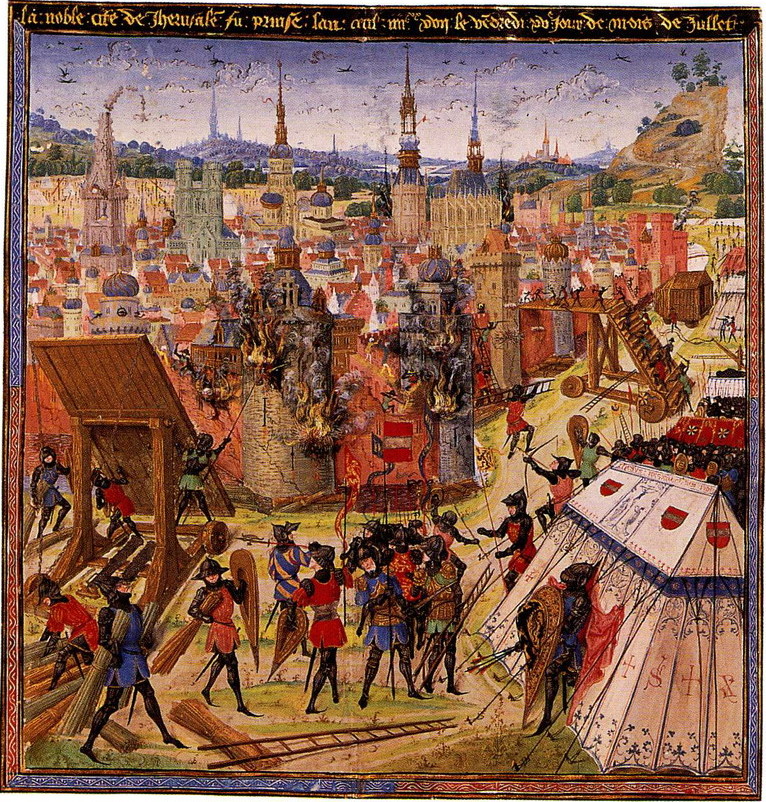
Medieval illustration of capture of Jerusalem during the First Crusade, 1099
Bethlehem lit "House of Flesh";, lit "House of Bread;" located in the central
West Bank and approximately 8 kilometers south of
Jerusalem,
The city was sacked by the
Samaritans in 529 AD but rebuilt by the
Byzantine emperor
Justinian I. Bethlehem was conquered by the
Arab Caliphate of
'Umar ibn al-Khattāb in 637, who guaranteed safety for the city's religious shrines. In 1099, Crusaders captured and fortified Bethlehem and replaced its
Greek Orthodox clergy with a
Latin one. The Latin clergy were expelled after the city was captured by
Saladin, the
sultan of
Egypt and
Syria.
Jerusalem is a holy city to the three major
Abrahamic religions—
Judaism,
Christianity and
Islam. In Judaism, Jerusalem has been the holiest city since, according to the Biblical Old Testament, King
David of Israel first established it as the capital of the
united Kingdom of Israel in c. 1000 BCE, and his son
Solomon commissioned the building of the
First Temple in the city.
Their identification as kings in later Christian writings is probably linked to Psalms 72:11,
“May all kings fall down before him”.
[4]
The
New Revised Standard Version of
Matthew 2:1–
12 describes the visit of the Magi:
The Magi are popularly referred to as wise men and kings. The word magi is the plural of Latin magus, borrowed from Greek μάγος magos,[5] as used in the original Greek text of the Gospel of Matthew. Greek magos itself is derived from Old Persian maguŝ from the Avestan magâunô, i.e. the religious caste into which Zoroaster was born, (see Yasna 33.7: "ýâ sruyê parê magâunô " = " so I can be heard beyond Magi "). The term refers to the priestly caste of Zoroastrianism.[6] As part of their religion, these priests paid particular attention to the stars, and gained an international reputation for astrology, which was at that time highly regarded as a science. Their religious practices and use of astrology caused derivatives of the term Magi to be applied to the occult in general and led to the English term magic. Translated in the King James Version as wise men, the same translation is applied to the wise men led by Daniel of earlier Hebrew Scriptures (Daniel 2:48). The same word is given as sorcerer and sorcery when describing "Elymas the sorcerer" in Acts 13:6–11, and Simon Magus, considered a heretic by the early Church, in Acts 8:9–13. However, there are some[who?] who argue that the magi might have been astronomers, and not astrologers.
Traditions identify a variety of different names for the Magi.
In the Western Christian church they have been commonly known as:
These names apparently derive from a Greek manuscript probably composed in
Alexandria around 500 A.D., and which has been translated into Latin with the title
Excerpta Latina Barbari.
[7] Another Greek document from the 8th century, of presumed Irish origin and translated into Latin with the title
Collectanea et Flores, continues the tradition of three kings and their names and gives additional details.
[8][9]
Origin and journey
The phrase
from the east, more literally
from the rising [of the sun], is the only information Matthew provides about the region from which they came. According to the
Gospel of Matthew, the Magi found Jesus by 'following' a star,
[15] which thus traditionally became known as the
Star of Bethlehem. Various theories have been presented as to what this phenomenon refers to, since stars do not visibly move and therefore cannot be followed. Some believe that they followed a planet, which without a telescope could be mistaken as a star, as it slowly moved across the sky.
On finding him, they gave him three symbolic gifts:
gold,
frankincense and
myrrh. Warned in a dream that Judean king Herod intended to kill the child, they decided to return home by a different route. This prompted Herod to resort to killing all the young children in Bethlehem, an act called the
Massacre of the Innocents, in an attempt to eliminate a rival heir to his throne. Jesus and his family had, however,
escaped to Egypt beforehand. After these events they passed into obscurity.
[16] The story of the
nativity in Matthew glorifies Jesus, likens him to Moses, and shows his life as fulfilling prophecy.
[17]
The
Code noir (
French pronunciation: [kɔd nwaʁ],
Black Code) was a decree originally passed by
France's King
Louis XIV in 1685. The Code Noir defined the conditions of
slavery in the
French colonial empire, restricted the activities of free
Negroes, forbade the exercise of any religion other than
Roman Catholicism (it included a provision that all slaves must be baptized and instructed in the Roman Catholic religion), and ordered all
Jews out of France's colonies. The Code Noir also gave plantation owners extreme disciplinary power over their slaves, including legitimizing corporal punishment as a method of maintaining control
The "Bulla" (Seal)
The most distinctive characteristic of a bull was its metal seal, which was usually made of
lead, but on very solemn occasions was made of
gold (as Byzantine imperial deeds often were).
The "bulla" depicted the founders of the Church of Rome, the apostles Peter and
Paul, identified by the letters
Sanctus
PAulus and
Sanctus
PEtrus. The name of the issuing pope was usually on the reverse side. The seal was then attached to the document either by cords of hemp (in the case of executory letters or letters of justice) or by red and yellow
silk (in the case of letters of grace), which was looped through slits in the
vellum of the document.
Bulla is the name of this seal, which to ancient observers looked like a bubble floating on water: Latin
bullire, "to boil."
Louisiana's Code Noir (1724)
Primary Documents:
To regulate relations between slaves and colonists, the Louisiana Code noir, or slave code, based largely on that compiled in 1685 for the French Caribbean colonies, was introduced in 1724 and remained in force until the United States took possession of Louisiana in 1803. The Code’s 54 articles regulated the status of slaves and free blacks, as well as relations between masters and slaves.


 guidance.
_-_James_Tissot_-_overall.jpg)